Generative AI is Here. Your Voice Agents Will Never Be the Same

For the last decade, "AI chatbots" and "voice assistants" have promised revolution but delivered frustration. We’ve all been trapped in robotic phone menus, desperately navigating a maze of "Press 1 for sales, Press 2 for support." We've all found ourselves yelling "AGENT" or "REPRESENTATIVE" at an unhelpful IVR (Interactive Voice Response) system that only understands a handful of rigid keywords.
These systems were a brittle facade of intelligence. They weren't smart; they were just complex decision trees.
Those days are over.
The engine behind this shift is Generative AI. It’s not just another tech buzzword; it’s the most significant leap in conversational computing we’ve ever seen. And for those of us building the next generation of voice and chat tools, it changes everything.
It’s the fundamental difference between a bot that can only read from a script and an agent that can understand the plot and write its own dialogue.
What is Generative AI? (And Why Is It So Different?)

Think of traditional AI, the kind that has powered bots for years, like a very good vending machine. You have to know the exact code (the "keyword") to press. If you press "B4" ("Check balance"), it gives you exactly that. If you ask for "the chips on the third row," it will fail. It only understands its pre-programmed inputs.
Generative AI is like hiring a personal chef. You don't give it a code; you give it a goal. "I'm in the mood for something spicy, but I'm allergic to peanuts." The chef can understand the nuance, check the pantry (your database), and create a new dish (a unique response) just for you.
Technically speaking, traditional AI is great at analyzing and classifying data. It can recognize a pattern, classify an image as a "cat," or identify a "spam" email.
Generative AI, powered by Large Language Models (LLMs), creates. Fed on massive datasets—a huge portion of the internet's text, code, images, and audio—these models learn the patterns of human language and reasoning. They don't just find information; they generate new, original, and coherent content.
Most importantly for us, they can hold a conversation that is context-aware, nuanced, and flexible.
Beyond Keywords: 4 Ways GenAI Transforms Conversational AI
For a platform like Intervo.ai, Generative AI isn't just an add-on; it's the new foundation. It moves our agents from "command-takers" to "collaborative problem-solvers."
Here’s what that looks like in practice.
1. From Rigid Scripts to True Conversational Flow
- Before (Traditional Bot):
- User: "I'd like to book a flight to New York."
- Bot: "Okay, flying to New York. What date will you be departing?"
- User: "Next Tuesday. Oh, actually, what's the weather like there?"
- Bot: "I'm sorry, I did not understand. Please state your departure date." (The bot has derailed. It cannot handle an interruption and must restart the "booking" script.)
- After (Generative Agent):
- User: "I'd like to book a flight to New York."
- Agent: "Sounds great. I can help with that. What date are you thinking of departing?"
- User: "Next Tuesday. Oh, actually, what's the weather like there?"
- Agent: "No problem. Looks like next Tuesday in New York will be partly cloudy with a high of 65. Still want to go ahead and book for that day?"
- User: "Yep, sounds good."
- Agent: "Perfect. And what city are you flying from?"
The generative agent can handle interruptions, multi-intent questions, and topic changes, just like a human would.
2. From Fixed Menus to Infinite Use Cases
Old bots could only do what you explicitly programmed them to do. This meant developers had to anticipate every possible question, which is impossible.
Generative agents can handle the "long tail"—the millions of unique, specific, and uncommon queries that make up the bulk of real-world interactions.
A traditional bot would fail at, "My package says it was delivered, but my security camera didn't show anyone at the door, and the tracking number looks weird. Can you check if the driver was even in my area?"
A generative agent can understand this complex, multi-part problem. It can infer the user is (1) reporting a missing package, (2) disputing the tracking status, and (3) implicitly asking for an investigation. It can then start the correct backend process without needing a "Report Missing Package With Weird Tracking" button.
3. From Robotic Text-to-Speech to Genuinely Human-like Interaction
This isn't just about the words; it's about the voice. The new generation of voice synthesis is also generative. Instead of stitching together pre-recorded phonetic sounds (which results in that classic, monotone "robot voice"), generative voice models create audio from scratch.
This means they can respond with appropriate and realistic tone, pacing, and intonation. They can sound empathetic when a customer is clearly frustrated or enthusiastic when confirming a successful booking. This drastically reduces conversational friction and builds trust, making the interaction feel helpful, not hostile.
4. From Information Retrieval to Autonomous Action
This is the most powerful part. A generative agent isn't just a "talker"; it's a "doer."
When you connect a generative model to your tools and APIs (Application Programming Interfaces), it can reason and act on its own. It's no longer just a search engine. It's an agent.
A user can say, "My internet is down. Can you fix it?"
An old bot would say, "Here is an article on 'How to Fix Your Internet.'"
A generative agent can:
- Reason: "The user's internet is down. I should check their account status first."
- Act (API Call 1): Check the user's account. Result: Active.
- Reason: "Okay, their account is active. I should try to reset their modem remotely."
- Act (API Call 2): Send a remote reset signal to the user's modem.
- Respond: "Okay, I've just sent a reset signal to your modem. It should restart in about 60 seconds. Can you let me know if the lights come back on?"
This ability to plan, use tools, and take action is what separates a simple chatbot from a true AI agent.
The Real Challenge: It's Not the "Brain," It's the "Body"

Here’s the reality for developers: having access to a powerful LLM is not the same as having a functional, enterprise-grade voice agent.
The "brain" (the generative model like GPT-4, Claude, or Llama) is incredibly powerful, but it needs a "body" to function in the real world. This "body" is the hard part—the complex infrastructure that developers spend months wrestling with.
This is the "plumbing" of conversational AI. How do you:
- Handle Latency? Stream audio from a phone call, send it for transcription, send it to the LLM, get a response, generate new voice audio, and stream it back, all in under a second so the conversation feels natural?
- Manage State? How do you keep track of the conversation's context, especially during long or complex calls?
- Handle Interruptions? What happens when the user starts talking before the agent is finished (called "barge-in")? Your system needs to stop talking immediately and listen.
- Integrate Securely? How do you safely give the AI agent access to your internal tools and customer databases?
- Scale? How do you do all of this for one user, and then scale it to handle thousands of concurrent calls?
This is precisely the problem we built Intervo.ai to solve.
Intervo.ai: Build Your Own Agents, Not Just Prompts
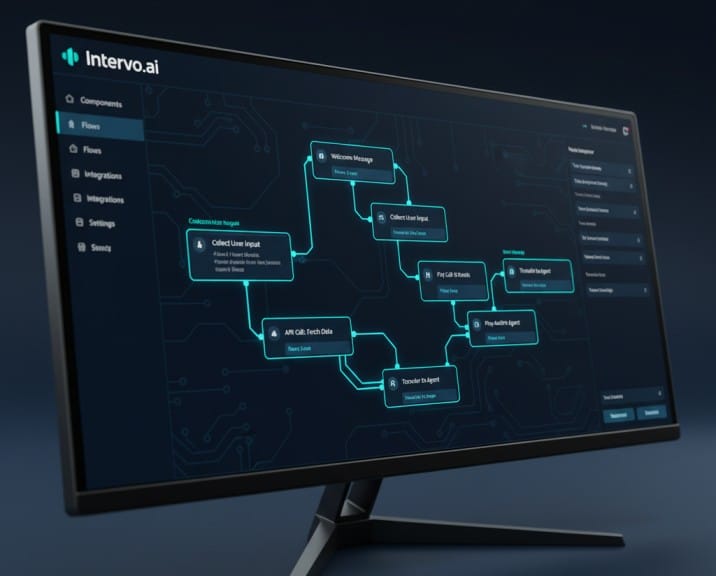
Generative AI provides the raw, world-class intelligence. Intervo.ai provides the open-source platform to harness it.
We handle the complex, real-time infrastructure of conversational AI. We give you the robust, scalable scaffolding (built with Node.js in the backend and React in the frontend) so you can stop worrying about latency, web sockets, and state management.
You get to focus on what matters: building a truly intelligent and useful agent for your specific needs, on your own terms.
The era of the dumb bot is over. The age of the intelligent, generative voice agent is here.
What will you build with it?
Frequently Asked Questions (FAQ)
1. What's the main difference between a Generative AI agent and a standard chatbot?
It comes down to Control vs. Comprehension. A standard chatbot follows a rigid, pre-programmed script (a decision tree). It can only do what you've explicitly told it to do. A Generative AI agent comprehends the user's intent in natural language and generates a new, unique response. It can handle topics and interruptions it wasn't explicitly programmed for.
2. Do I need to be a data scientist and train my own model to use this?
No. That's the beauty of the current ecosystem. You can access incredibly powerful, pre-trained models from companies like OpenAI (GPT-4), Anthropic (Claude), or Google (Gemini) via a simple API call. Or, you can use powerful open-source models like Llama or Mistral. Your job isn't to build the brain, but to integrate it.
3. So, is Intervo.ai a Large Language Model (LLM)?
No, we are the platform that makes LLMs useful for real-time voice. Think of an LLM as a brilliant brain in a jar. Intervo.ai is the "body"—the complete system (built on Node.js and React) that connects that brain to the real world. We handle the real-time audio streaming, interruption (barge-in), state management, and API connections, so you don't have to build all that complex infrastructure from scratch.
4. What about AI "hallucinations"? How do you stop the agent from making things up?
This is a critical part of agent design. You don't just ask the LLM a general question; you ground it. This is done through "prompt engineering" (giving it strict rules, like "You are a customer support agent and must not discuss the weather"), "Retrieval-Augmented Generation" (RAG) (giving it specific documents to read from), and "tool use" (forcing it to get answers from your company's API instead of its own memory). Our platform is designed to help you build these guardrails.
5. If Intervo.ai is open-source, does that mean it's free?
Yes, our platform is open-source and free to use. You can host it yourself and modify it however you like. You are still responsible for the "compute" costs, which means paying for the API calls to your chosen LLM (like OpenAI) or the server costs to host your own open-source model. We provide the car; you provide the gas.