Kore.ai Review 2025: The "Enterprise Giant" vs The Reality of Shipping Fast
The Elephant in the Server Room
Let’s be honest for a second. If you run a SaaS company or lead a product team, you know the anxiety of picking infrastructure. It’s not just about features anymore; it’s about making a bet on the future.
You make the wrong choice, and six months down the line, you’re stuck. You’re bleeding cash on a contract you can’t escape, fighting with a tool that requires a PhD to configure, and explaining to your board why the "AI revolution" you promised is stuck in implementation purgatory.
If you’re looking at Kore.ai, you’re looking at the heavyweight champion. It’s the "safe" bet. It’s the IBM of conversational AI. It’s massive, it does everything, and nobody gets fired for hiring them.
But here is the question I want to ask you, founder to founder: Do you actually need an aircraft carrier, or do you just need to get across the river?
In this review, we’re going to cut through the marketing fluff. We’ll look at what Kore.ai actually is, where it shines, where it stumbles, and why a shift toward open, agile tools like Intervo.ai might be the sanity check your dev team needs.
What is Kore.ai, Really?
Kore.ai calls itself an "Experience Optimization (XO) Platform." That’s a fancy way of saying it’s a massive toolkit designed to let Fortune 500 companies build chatbots and voice assistants across every channel imaginable—WhatsApp, web, SMS, phone lines, you name it.
It creates a "universal brain" for customer service.
The Engine Under the Hood
Technically, it’s impressive. It uses a mix of three different engines to understand what a human is saying:
- Fundamental Meaning: It looks for keywords.
- Machine Learning: It learns from patterns.
- Knowledge Graph: It understands relationships between concepts.
It also plays nice with the dinosaurs of the telecom world—legacy IVR systems. It can read old VoiceXML files and integrate with on-premise setups that banks rely on.
In short: It’s built for the enterprise. It’s built for companies that have compliance officers, 18-month procurement cycles, and legal teams larger than your entire startup.
The Good Stuff (Because Credit is Due)
I’m not here to bash a competitor just for the sake of it. Kore.ai is a powerhouse for a reason.
- The "Build Once, Deploy Everywhere" Dream:
If you are a massive bank with siloed teams, Kore is great. You build a flow once, and it works on Facebook Messenger just as well as it works on your 1-800 number. That centralization is seductive for disjointed organizations.
- The Visual Builder:
They have a decent drag-and-drop interface. It allows non-technical business analysts to map out conversation trees ("If user says X, do Y"). It democratizes the design process so you don’t always need a developer for a text change.
- Security Theater (The Good Kind):
If you need to pass a SOC2 audit or a HIPAA review yesterday, Kore.ai has the paperwork ready. They have checked every regulatory box in existence.
The Reality Check: Where "Enterprise" Becomes a Burden
Here is the part the sales brochures leave out. This is the friction that kills agility.
1. The Latency Lag (The "Hello? Are you there?" Problem)
In text chat, a 2-second delay is fine. In voice? It’s fatal.
When you speak to an AI, you expect an immediate response. Kore.ai’s architecture is heavy. By the time the signal goes from the phone carrier -> Kore’s cloud -> their NLU engine -> your backend -> back to Kore -> Text-to-Speech engine -> back to the user, you’re looking at 800ms to 1000ms (or more) of latency.
That sounds small, but try pausing for a full second every time you finish a sentence in a real conversation. It feels broken. People start talking over the bot. The illusion shatters.
2. Complexity is a Feature (And a Bug)
Kore.ai isn't something you just "plug in." It’s a lifestyle choice.
- The Setup: A typical deployment isn't days; it’s months. Sometimes 6 to 18 months. In the SaaS world, 18 months is a lifetime. By the time you launch, the market has moved on.
- The Skill Gap: You can’t just hand this to a junior React developer. You often need certified Kore.ai consultants to manage the complexity of the dialogue flows.
3. The Pricing Black Box
Kore.ai doesn't usually put pricing on their website for a reason. It’s expensive.
- The Sticker Shock: We’re talking enterprise contracts that often start in the $50,000 to $300,000+ range per year.
- The Lock-In: These are usually multi-year commitments. If you realize three months in that it doesn't fit your use case? Too bad. You’re on the hook.
The Strategic Pivot: Why We Built Intervo.ai
We looked at the landscape and saw a gap. On one side, you had simple, "toy" tools that couldn't handle real business logic. On the other, you had giants like Kore.ai that were too slow and expensive for modern builders.
We didn't want a walled garden. We wanted a workshop.
So, we built Intervo.ai.
We aren't trying to be "Kore.ai Lite." We are trying to be the open-source infrastructure for the next generation of voice AI.
1. Latency That Actually Feels Human
We stripped the bloat. We obsessed over milliseconds. By optimizing the pipeline between listening, thinking (LLM), and speaking (TTS), Intervo achieves sub-500ms latency.
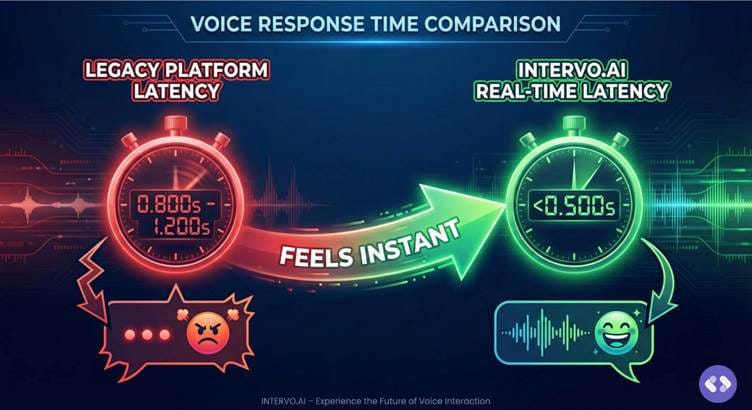
- Why it matters: It handles interruptions. If a user interrupts the bot, Intervo stops talking instantly and listens. It feels like a real conversation, not a walkie-talkie exchange.
2. You Own the Data (Self-Hosted)
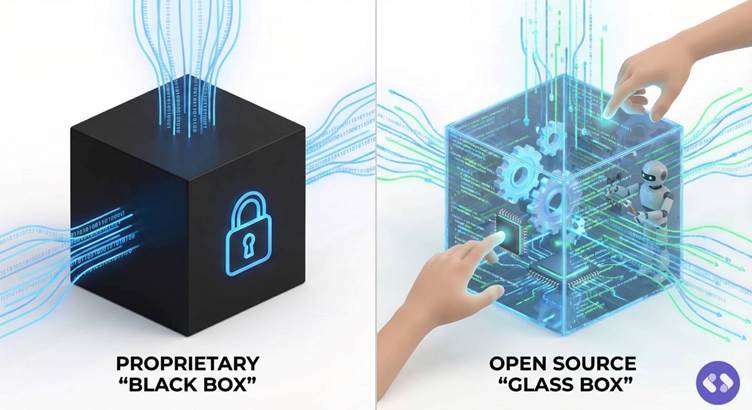
This is the big one. In a world where data privacy is everything, do you really want to send all your customer voice recordings to a third-party black box?
- The Open Source Edge: Because Intervo is open-source, you can take our code and run it on your own servers.
- Compliance: Need to keep data in the EU? Need to air-gap your system for healthcare security? You can. You don't have to ask us for permission; you just do it.
3. Developer-First, Not Consultant-First
We built Intervo for people who write code.
- No Black Boxes: You want to inject custom Python script right in the middle of a call? Go ahead. Want to swap out the LLM from GPT-4 to Claude or a local Llama model? Easy.
- Webhooks Everywhere: Connect to your CRM, your database, or your proprietary internal tools using standard APIs.
4. Pricing That Doesn't Punish You
We believe you should pay for value, not shelfware.
- The Model: We have a transparent, usage-based model. If you don't use it, you don't pay.
- The Free Tier: You can download the open-source version and start building for free. Right now. No credit card, no sales call, no "let me check with my manager."
The Head-to-Head
Let’s simplify this for your decision-making process:
|
If you care about... |
Kore.ai is for you if... |
Intervo.ai is for you if... |
|
Speed |
You have 6-12 months to deploy. |
You want a prototype today and production next
week. |
|
Budget |
You have a six-figure annual budget. |
You want to pay for usage or host it yourself for free. |
|
Control |
You prefer a managed, "safe" vendor. |
You want code-level control and data sovereignty. |
|
Experience |
You are okay with ~1 sec latency. |
You need real-time, human-like voice speed. |
|
Philosophy |
Closed Ecosystem. |
Open Source. |
Final Thoughts: Future-Proofing is About Agility

As a Strategist, I see founders make the same mistake over and over: they buy the tool with the most features, rather than the tool that gives them the most freedom.
Kore.ai is a solid, legacy choice. It’s the "safe" answer for a rigid corporation.
But if you are building a SaaS that needs to adapt, scale, and actually delight your users with speed and intelligence, you cannot afford to be locked in. You need the keys to the engine room.
The future of AI isn't in a box you buy. It's in the code you build.
Ready to see the difference?
Stop reading brochures and start shipping. Check out Intervo.ai on GitHub or Start building your first agent for free at Intervo.ai.
Frequently Asked Questions
Q: What is the main difference between Kore.ai and Intervo.ai? A: Philosophy and speed. Kore.ai is a massive "all-in-one" enterprise platform designed for Fortune 500s with long procurement cycles. Intervo.ai is an open-source, developer-first infrastructure designed for startups and agile teams who need to ship fast and control their own code.
Q: Why does Intervo.ai claim to be faster for voice AI? A: Latency. Kore.ai’s heavy architecture often results in delays of 1 second or more, which causes users to talk over the bot. Intervo optimizes the pipeline between listening, thinking (LLM), and speaking (TTS) to achieve sub-500ms latency, making conversations feel human and handle interruptions naturally.
Q: Can I host Intervo.ai on my own servers? A: Yes. Unlike Kore.ai, which is a closed "black box" SaaS, Intervo is open-source. You can self-host it to ensure total data sovereignty, maintain strict compliance (like HIPAA or EU regulations), and avoid sending sensitive voice data to third parties.
Q: How does the pricing compare? A: Kore.ai typically requires expensive, multi-year enterprise contracts (often $50k-$300k+). Intervo.ai offers a transparent usage-based model with no lock-in. You can also download the open-source version and build for free without a credit card.
Q: Do I need certified consultants to use Intervo.ai? A: No. Kore.ai often requires certified experts to manage its complex proprietary tools. Intervo is built for developers—you can use standard code (Python, etc.) and webhooks to integrate it with your existing stack immediately.
Q: Which one is better for a quick prototype? A: Intervo.ai. A typical Kore.ai deployment can take 6 to 18 months. With Intervo, you can start building immediately and move from prototype to production in days, not years.