The 3 Silent Killers of Real-Time Voice Agents
Let’s be honest for a moment. We’ve all seen the demos. You know the ones. A polished video on Twitter or LinkedIn shows someone talking to an AI that responds instantly and perfectly, with just the right amount of witty banter. It looks like magic. It feels like the future we expected from every sci-fi movie, from Star Trek to Her. But then, you try to build it yourself. You sign up for the APIs. You connect a speech-to-text model, a language model, and a text-to-speech engine, and you excitedly make your first call. And what happens?
• Silence. A long, awkward pause while the server processes the request.
• Confusion. The bot begins making up facts about your product that don’t exist.
• Frustration. You realize you have no clue how to link this cool brain to your CRM or phone lines without writing thousands of lines of custom code.
I’ve been there. Our team has been there. As marketers and engineers in this space, we understand that the gap between a "cool prototype" and a "production-ready business tool" is a huge divide filled with engineering challenges. At Intervo.ai, we didn't just want to create another chatbot wrapper. We aimed to tackle the core infrastructure issues that prevent businesses from truly using voice AI. We spent months figuring out why most voice projects fail, and it almost always boils down to three specific, frustrating challenges. Here is what creates the bottleneck in real-time conversational AI, and how we redesigned the stack to fix it.
Challenge #1: The "Awkward Silence" (Latency That Kills the Vibe)

In the world of text chatbots people do not mind waiting a bit. If you ask a question in a support chat and you see the three little dots moving for a seconds it is not a big deal. You are probably looking at your email in another tab at the time anyway. The text chatbots are just waiting for your question, like the support chat is waiting for you to type something else.
But voice is different. Voice is primal.
In a human conversation, the typical gap between one person finishing a sentence and the other starting is roughly 200 to 300 milliseconds. That is incredibly fast. If you pause for more than 500 milliseconds, the other person instinctively thinks you didn’t hear them, or worse, that the call dropped. They start saying, "Hello? Are you there?" right as your bot finally starts speaking. The result? You talk over each other, the AI gets confused, and the experience falls apart.
The Engineering Nightmare
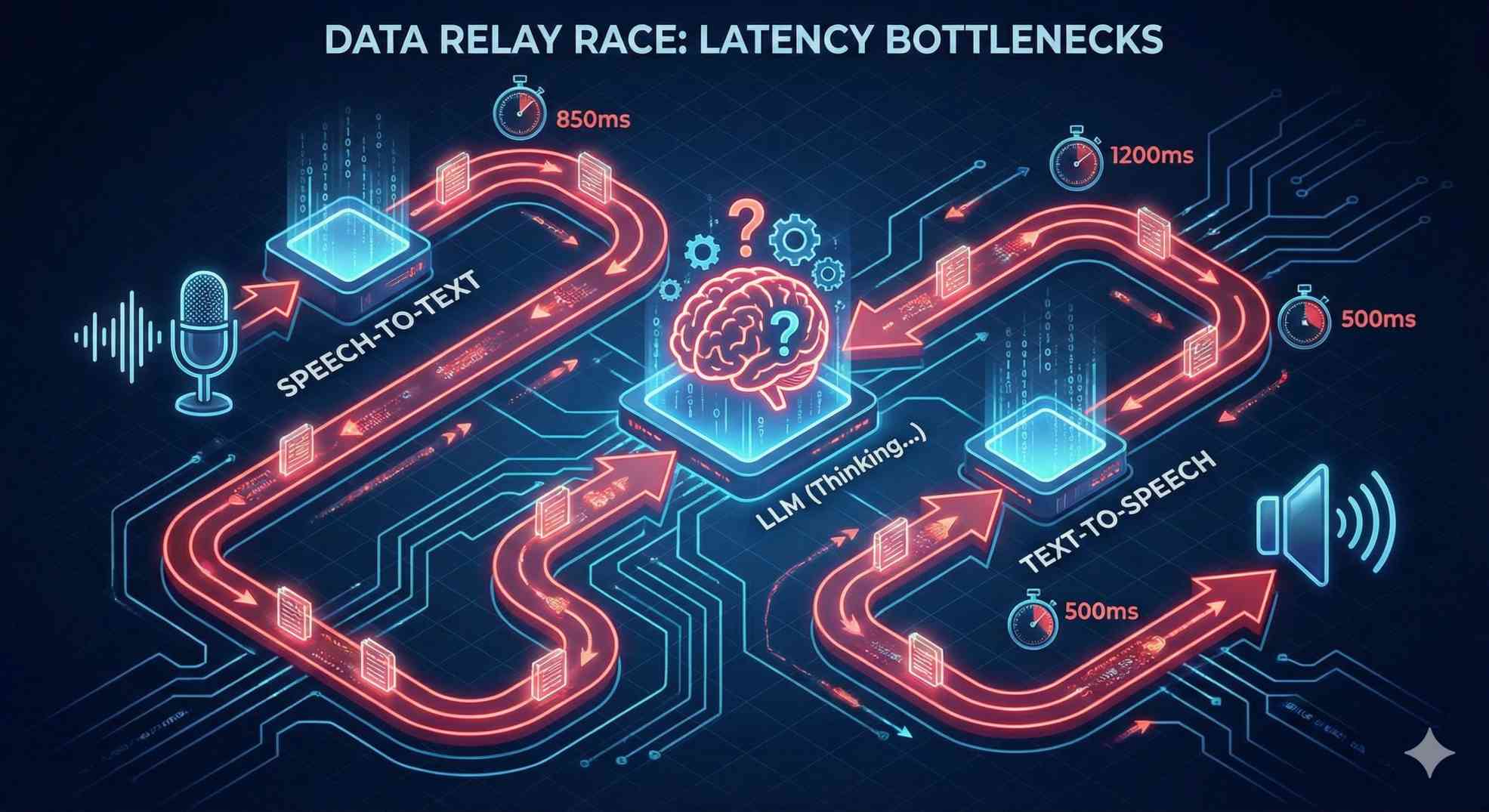
The problem isn't just one slow component; it’s the "relay race" of the modern AI stack. To make a voice agent work, you typically have to:
- Transcribe the user's audio (Speech-to-Text).
- Send that text to an LLM (like GPT-4 or Claude) to "think."
- Wait for the tokens to generate.
- Send those text tokens to a voice engine (Text-to-Speech) to generate audio.
- Stream that audio back to the user.
Milliseconds are added with each handoff. There may be a 500 ms delay here, a 300 ms delay there, and all of a sudden there will be a 3 second delay. A three-second delay in a customer service or sales call is more than just an annoyance; it's a deal-breaker. It gives the impression that your brand is inept.
How Intervo Solves It
We came to the conclusion that you can't simply put APIs together and hope for the best. An orchestrated runtime that aggressively optimizes this flow is required.
Intervo reduces this "time-to-first-byte" by handling the exchange as a continuous stream as opposed to a sequence of discrete requests. We interface with the fastest engines available, such as ElevenLabs or Deepgram for ultra-low latency voice synthesis and Groq for nearly instantaneous inference. More significantly, though, our architecture manages the disruptions.
Intervo's engine naturally handles a "barge-in" when a customer interrupts the bot in the middle of a sentence, instantly halting the audio stream and listening to the new input. In order to make the conversation feel natural rather than robotic, we transformed the "relay race" into a synchronized dance by eliminating valuable milliseconds.
Challenge #2: The "Hallucination Risk" (Why Business Bots Can't Just "Wing It")

It's endearing when an NPC in a game (like Inworld's focus) invents a tale about a dragon. The lore is enhanced.
In the business world, you face a financial and legal catastrophe if your AI agent misrepresents the monthly cost of your enterprise software to a prospective client as $10 when it actually costs $1,000.
Control is the second major obstacle in real-time AI. Because generic LLMs are trained on the entire internet, they are excellent at small talk but terrible at following your particular business policies. They enjoy being helpful, even if it means creating features you don't have in order to satisfy the user.
The "Prompt Engineering" Trap
The majority of developers attempt to address this by creating lengthy system prompts, such as "You are a helpful assistant." Don't tell lies. Use this data only.
But that prompt turns into a messy novel as your product expands. You reach the limits of context. Because it is concentrating on the end of the prompt, the bot begins to forget instructions at the beginning. Just trying to "jailbreak-proof" your own bot—changing words and hoping it doesn't go crazy during a live support call—takes up half of your engineering time.
How Intervo Solves It: Grounded Truth
Intervo was designed with business in mind. Instead of depending solely on a prompt, we employ an advanced RAG (Retrieval-Augmented Generation) system that is integrated right into the platform.
Intervo indexes the PDFs, website links, and policy documents you upload to your knowledge base into a vector database that the agent can query instantly. The AI doesn't just "guess" before speaking; it uses your data to determine the precise policy or cost.
You can create formal Workflows through our system. You can drag-and-drop a flow that says, "If the user asks for a refund, DO NOT answer. Instead, collect their order number and route them to a human." The system provides natural conversation capabilities through its LLM while its business processes require use of its strict logic tree system. The solution functions as an essential protection mechanism which enables companies to implement AI technology without experiencing operational disruptions.
Challenge #3: The Integration "Spaghetti Code"

The information given shows that you developed advanced capabilities to overcome both latency and hallucination problems. Your performance now includes running an extremely rapid intelligent bot which operates without any environmental contact. A voice agent that has no operational capabilities functions as an advanced frequently asked questions section. The agent provides genuine worth to users when it performs calendar checks, Salesforce lead status updates, and password reset email functions..
The Developer's Burden
Connecting a voice agent to the real world is historically painful.
- You have to set up a Twilio account and manage SIP trunking (telephony networking).
- You have to handle WebSocket connections for the audio stream.
- You have to write webhooks to talk to your CRM.
- You have to figure out how to authenticate everything securely.
The "AI project" has transformed into a "DevOps project" because you have dedicated multiple weeks to developing essential code components which enable phone calls instead of improving dialogue effectiveness. The organization becomes unable to develop new innovations because technical debt prevents them from creating new products. The sales script cannot undergo A/B testing because it exists as a permanent element within your backend system
How Intervo Solves It: The "Plug-and-Play" OS
We decided that "infrastructure" shouldn't be your problem. Intervo is designed as an end-to-end Operating System for voice agents.
- Telephony is built-in: You don’t need to be a telecom engineer. Buy a number directly inside Intervo or bring your own Twilio credentials, and the SIP trunking is handled automatically.
- Integrations are native: We have pre-built connectors for the tools you actually use—HubSpot, Salesforce, Zapier, and more.
- Action-Oriented: You can equip your agent with "tools." You simply tell the agent, "Here is a tool called 'CheckInventory'. If the user asks about stock, use this tool." Intervo handles the API call and feeds the result back to the conversation seamlessly.
We transformed several months of integration work into a process that requires only two mouse clicks to complete. The system enables marketing teams and product managers to test new experience designs because they no longer need to request engineering resources for every webhook change.
The "Open Source" Difference: Why We Opened the Hood
Trust represents the primary obstacle which people must overcome because it exists between engineering and business operations.
You build your system based closed ecosystems which control all your operations. You must pay whenever they decide to increase their fees. You experience anxiety whenever they modify their rules about customer information protection. Your system becomes unusable whenever their system experiences downtime.
The future of AI infrastructure needs to achieve complete transparency according to our beliefs. Intervo maintains an Open Source foundation because it represents our core values. We provide you with the complete software code. You can self-host it if your organization needs to comply with data residency regulations (such as GDPR or HIPAA). The system shows you our complete procedure for handling customer information. You gain the ability to change the agent's intelligence system whenever your requirements exceed our current product capabilities.
Most platforms try to lock you in. Our system enables you to eliminate repetitive tasks while you pursue your creative work but we provide you with complete control over your technology infrastructure.

Stop Building Infrastructure, Start Building Agents
We created Intervo because we became tired of witnessing exceptional AI concepts fail during the "integration phase." The system should provide developers and knowledgeable founders with the ability to move their projects from "idea" to "live phone number" within an afternoon instead of needing three months to complete the process.
The challenges of latency, context, and integration are real, and they are difficult. The issues become solvable when you establish the appropriate foundation.
Your team should not spend their time on WebSocket stream debugging or audio codec problems. Intervo will handle all the required work for you. Your task is to create the ideal dialogue while our team ensures its continuous real-time execution.
Ready to build an agent that actually works? Try Intervo for free today and make your first call in minutes.